
 Aug
06
Aug
06
Load Restraint Performance Standards Explained
- 06/08/2026
- 0 Comment(s)
What Are the National Load Restraint Performance Standards? Your Legal Obligations Explained
If you’re loading, packing, driving or managing freight in Australia, “she’ll be right” isn’t a load restraint strategy, it’s a legal risk. As Australia’s only 100% load restraint specialists, we get asked constantly: how much restraint is actually enough? The answer isn’t a guess. It’s written into law as the Loading Performance Standards, and every operator in the supply chain is responsible for meeting them.
The forces your load restraint system must withstand
Under the Heavy Vehicle National Law, a load restraint system must be strong enough to stop your load moving under normal driving conditions. This includes emergency braking and minor collisions. Specifically, your restraint needs to withstand:
- 80% of the load’s weight forwards (from braking)
- 50% of the load’s weight rearwards (from acceleration or braking in reverse)
- 50% of the load’s weight sideways (from cornering)
- 20% of the load’s weight vertically, if you’re relying on friction to hold the load in place
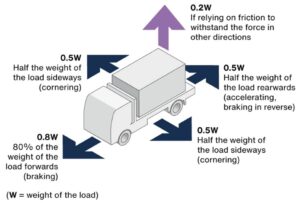
(Image credit: NHVR Load Restraint Guide 2025 – nhvr.gov.au/road-access/loading/loading-performance-standards)
These aren’t arbitrary numbers. They reflect the real forces a loaded vehicle experiences on Australian roads, and if your restraint system can meet them, your load won’t come loose or destabilise the vehicle under expected driving conditions.
Why “she’ll be right” gear doesn’t cut it
Unrated straps, old rope, or mismatched chains and binders might look like they’re doing the job, until they’re tested by a hard stop or a sharp corner. The law is clear: if part or all of a load comes off a vehicle, that’s treated as evidence the restraint system failed to meet the standard. Every party who can influence restraint and loading, from the consignor to the driver, shares responsibility for getting it right.
This is exactly why we only supply load restraint equipment that’s rated and compliant with Australian Standards, including AS/NZS 4380:2001 for webbing and AS/NZS 4344 for chain assemblies. When you buy from Load Restraint Systems, you don’t have to guess if your load will hold, you know it will.
Choosing the right restraint method for your load
The Performance Standards don’t dictate how you restrain a load, only that it has to hold. That means you can tie it down, block it, contain it, or directly lash it, as long as the system meets the required forces.
For most general freight, a combination of rated webbing straps or chains, correctly tensioned and angled, will get you there. Webbing straps are the go-to for palletised goods, machinery and general freight because they’re lightweight, easy to tension with a ratchet, and gentle enough not to damage the load. Chains suit heavier, more rigid loads such as steel, timber or plant equipment, where a webbing strap alone wouldn’t provide enough capacity. For loads that are slippery, offset, or awkward, direct restraint is often a better fit than relying on friction across the deck.
Whatever combination you choose, every webbing strap, chain or binder in the system needs a legible rating tag and should be inspected before each trip. A strap with cuts, fraying or UV damage won’t perform to its rated capacity, no matter what the tag says.
Don’t forget towing and trailer obligations
Load restraint obligations don’t stop at what’s strapped down in the tray. If you’re towing a trailer, car carrier, or plant equipment, the same fit-for-purpose principle applies to your tow strap and trailer hooks.
A quality tow strap, correctly rated for the vehicle or load being towed, reduces the risk of snapping or slipping under load, critical whether you’re recovering a stuck vehicle or loading a car onto a tilt tray. Likewise, trailer hooks and safety chain kits need to be rated and correctly fitted, so that if a coupling ever fails, the safety chain holds the trailer in place rather than letting it come loose on the road. It’s a legal requirement for towing in Australia, not just good practice.
Talk to the Australian specialists
With 30+ years supplying the transport, materials handling and industrial sectors across Australia, we know exactly what it takes to get your load restraint system compliant, not just close enough.
Browse our range of Ratchet Tie Downs and Assemblies, Webbing and Hardware, and Chains and Fittings, or check out our dedicated Tow Straps and Car Carrying and Vehicle Safety Chain Kits ranges. Or contact us on 1300 577 797 and we’ll help you build a restraint system that meets the standard, from the tray to the tow bar.
Source: National Heavy Vehicle Regulator, Load Restraint Guide 2025.